Thursday, March 26, 2015

Spring Break—an ideal time for campus visits


If you are a parent of a stressed out high school junior, don’t panic—you can visit college campuses either in person or virtually and come away with a 360 degree view of a school in either case.
Whichever route you take, actual or virtual, consider visiting or researching different types of schools: research universities and liberal arts colleges; rural, suburban and urban campuses; private and public universities.  

By experiencing the the overall “vibe” of different campuses, students can begin to focus their college list further, even if they don’t visit all the schools they are interested in. 

Also, it’s a good idea to visit some schools that may only moderately interest or attract your student as during the year between junior and senior spring, young people’s ideas and attitudes can evolve quite a bit.

For tips on planning a college tour, check out an earlier PYW College Search Blog Post: 


And for virtual tours, visit:


Both sites offer full online campus tours as well as videos of students, professors and school events that give viewers a more complete picture of campus life.


Monday, March 2, 2015

Living and Learning at Cal Poly San Luis Obispo


On our return from our college visit trip to LA a couple of weeks ago, we stopped at Cal Poly San Luis Obispo.  The most selective of the CSU campuses, Cal Poly enrols approximately 19,000 students with about 4,500 students per undergraduate class.

Touring the campus with Theresa, a current first year architecture student, gave us an inside view of the university as well as her particular experience in the “Living Learning Program,” a unique opportunity for students to combine their educational and social lives through their campus housing. 

We met Theresa at her residence hall, one of the six “Red Brick” dormitories, which comprise the “Living Learning Program.” Theresa lives in “Sequoia,” a residence of 270 students, 90 per floor, all of whom are enrolled in the same academic program as she is.  She lives in a double on an all women’s hall.  Her room (11’x13’x9’) is well-maintained, spacious enough for a bed, dresser, wardrobe, three drawer filing cabinet, desk and mini-fridge.  It is functional rather than aesthetic.  Some of the rooms on the hall are triples, the same sized room which, amazingly, fit enough furniture for three students.  When we passed through the spacious, clean common rooms, they were in use by small clusters of students, some of whom appeared to be studying, while others were socializing.  The whole atmosphere was comfortable and low-key.

Theresa explained that most classroom buildings on campus also belong to a particular program or major such as business or engineering though a certain percentage of general education classes are held in each location.  The architecture program is located near the engineering quad and contains large studios where each quarter she is assigned a “space” along with about 40 other students in her class. 

Theresa in her design studio
Classroom building for architecture
She has 24/7 access to the studio and this is where she completes a lot of her design projects.  Each quarter this year she takes two general education courses and the rest of her academic schedule is devoted to her architecture study/studio work.  In the fall her composition class had only about 20 students and her physics course there were about 20 students.  This winter quarter she is enrolled in big lecture survey courses of between 100-200 students each.  She is really enjoying both of these survey courses, art history and architectural history as they relate directly to her major.

Theresa described a couple of the benefits of Cal Poly’s five-year architecture program: in her fourth year she will have a hands-on internship, which could be in an international location like Copenhagen or Switzerland.  As part of a pilot program, this year she has been paired with a peer mentor, a third year student in the architecture program who gives her advice about coursework, summer jobs and other topics. 

Social life for Theresa is pretty low key.  We toured the nearby town of San Luis Obispo (close enough to walk to but there is also a shuttle), where we ate lunch in a inexpensive deli-type restaurant.  There are numerous other casual restaurants and coffee shops, chain stores for clothing and other goods, a movie theatre. Theresa has made friends with her roommate and with other students in her program/residence hall.  The program-based housing appears to be both an academic and social benefit for her.


Overall, I was favorably impressed by Cal Poly’s campus and by Theresa’s experience in the Living Learning Program.
Tuesday, February 17, 2015

The Claremont Colleges—the appeal of a liberal arts consortium


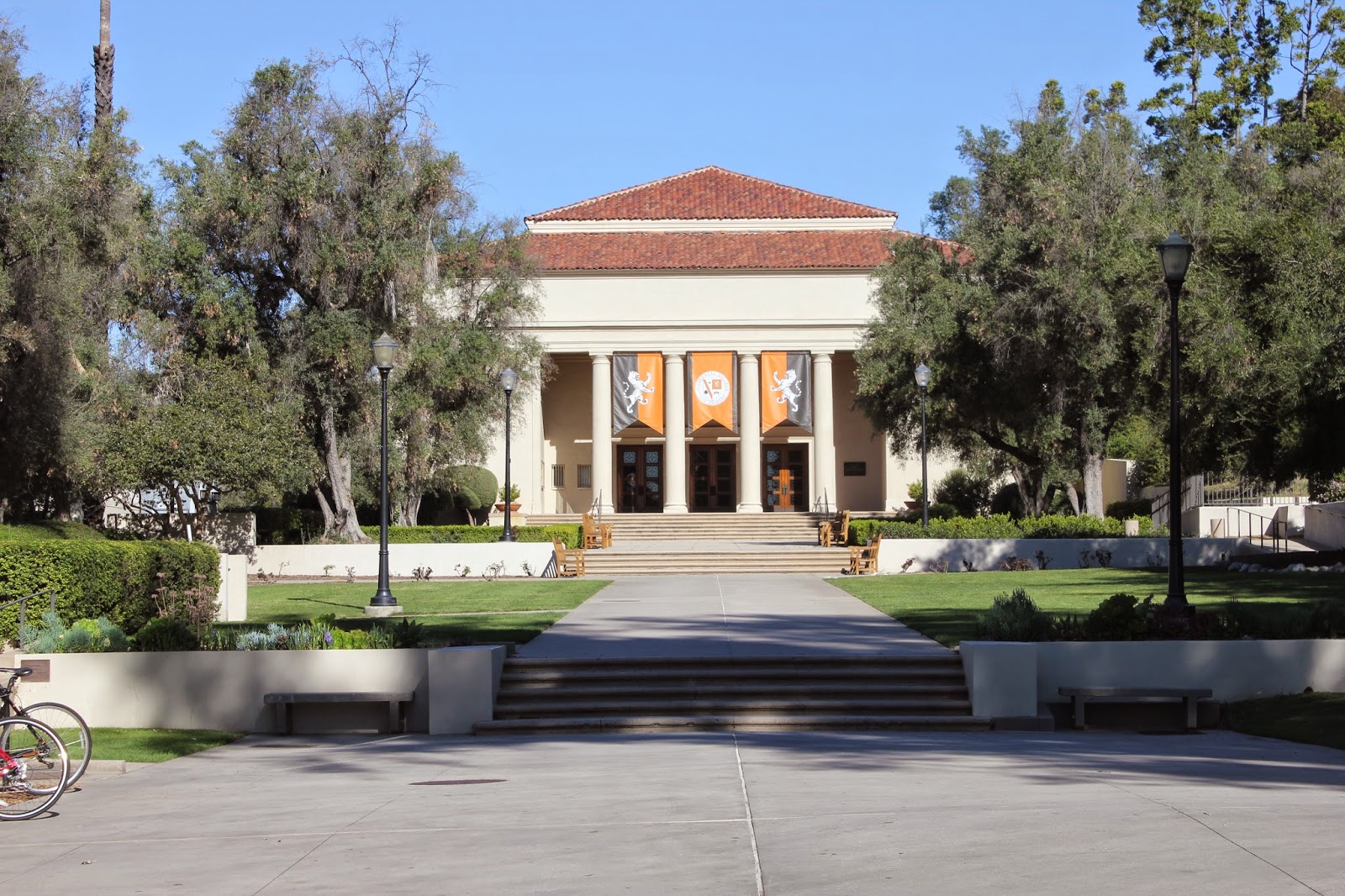
My daughter Abby and I just returned from a road trip to LA where we visited the Claremont Colleges, Occidental and USC.  After attending information sessions, campus tours and wandering around campus observing and talking with students, I am sold on the advantages of a liberal arts college consortium—as it combines the best of a small school with the resources of a larger one.

The Claremont Colleges are five liberal arts schools and two small graduate programs all located
Clock Tower at Pomona
within one square mile in the city of Claremont, about 35 miles east of downtown Los Angeles.  The five schools range in size from about 800 (Harvey Mudd) to 1500 students (Pomona). 

Each of the five colleges has a distinct mission, focus and curriculum yet all five share common resources including a shared course catalogue accessed by all students who can take up to 30% of their courses at any of the other institutions, a library of 2 million volumes, a concert hall, bookstore, facilities and joint sports teams (Pomona/Pitzer and Claremont McKenna/Harvey Mudd/Scripps).  Students can eat at any one of seven dining halls and many social and social justice activities occur outside individual school boundaries. 

Meanwhile on each campus, class sizes are small, student-professor
Residence Hall Courtyard at Pomona
relationships are warm and nurturing and students can pursue their own passions surrounded by like-minded friends.  Pomona is the traditional liberal arts school; Pitzer is the ‘60s activist campus; Claremont McKenna focuses on politics and leadership while Harvey Mudd features engineering and science and Scripps is a women’s college. 


Mural at Pizter
Abby was drawn to both Pomona and Pitzer so we visited those campuses more in depth and we were both favourably impressed by our student guides and the engaged yet casual “vibe” on each campus.  In recent years following Pomona all of the Claremont schools have become quite competitive so admittance is very selective.  If you are drawn to a liberal arts curriculum and want to attend college in the west, any of the Claremont schools is a very attractive option.
Desert landscaping at Pitzer

Organic Garden at Pitzer
(If you want the liberal arts consortium advantage but prefer to leave California you might consider the Massachusetts Five College Consortium of Amherst, Hampshire, Smith, Mt. Holyoke and U Mass Amherst or the Tri-College Consortium of Bryn Mawr, Haverford and Swarthmore outside Philadelphia.)


Wednesday, February 4, 2015

Jesuit Universities—a Great Choice for Social Justice Oriented Students

This week I visited Santa Clara University for an in-depth look at a Jesuit university.  Santa Clara is one of three Jesuit institutions in California along with Loyola Marymount and the University of San Francisco. 

The Jesuits, an order of Catholics, have been known for their dedication to the education of the whole person.  Contrary to what some students might assume, a student at Santa Clara or another Jesuit University does not need to be Catholic or even Christian to attend. 

Santa Clara’s curriculum reflects the Jesuit approach to develop well-rounded individuals through broad and deep studies of many disciplines.
Santa Clara University Library

Key elements include:
--a core curriculum that features the liberal arts
--emphasis on global citizenship and service learning
--community engagement

Here are a few highlights of what I learned during my tour:

*Santa Clara was founded in 1851, the older higher education institution in California. It houses three undergraduate/graduate schools: Arts and Sciences, Business and Engineering.
University Residence Hall

*Current enrollment is 5,400 undergraduates.  In 2014 over 15,000 applications were submitted.

*The fastest growing major at Santa Clara is environmental studies.  There is a strong pre-med program with excellent medical school placement.

*The university offer many internship opportunities in high technology companies.

*In 2003 the Global Social Benefit Institute was founded to help solve international poverty through a sustainable impact business model.

*Multiple immersion trip opportunities give students the chance to encounter challenging situations within a safe environment.

*Santa Clara boasts a 97% retention rate from freshman to sophomore year.

While Santa Clara is not a smaller Stanford, it does offer rigorous and stimulating academics in a similar Silicon Valley environment.  For students with an international perspective who want to make a positive impact on the world it’s worth a careful consideration for the college list.


Friday, November 7, 2014

Girls and STEM—How to encourage young women to study science


I read an editorial recently, “AcademicScience Isn’t Sexist,” that claims women aren’t facing discrimination in the academy as much as failing to make educational choices early on that include science.

According to researchers, from a young age girls tend to show more interest in people and animals compared to boys who tend to prefer building and playing with machines.  During adolescence as a
consequence, girls are less interested in engineering and computer science.  Even though girls earn higher grades than boys throughout the K-12 years, they are less likely to take advanced courses in physics and calculus.  In college this pattern continues. 

How can we break this cycle?

One way is to encourage girls to take more advanced level math and science courses in high school.  Another way is to encourage young women to take introductory science courses near the beginning of their college years.  If they do so, studies show that they are more likely to choose a math-intensive science major. 

Currently, women make up 80% of graduates from veterinary school and 70% of recent psychology PhDs.  Wouldn’t it be great if the percentage levels of their participation in engineering, computer science and physics could climb at least toward 50%?

In addition to encouraging your daughter to take more advanced math and science in school you might also suggest she enroll in a summer science enrichment program.  Two possibilities are:

COSMOS: California State Summer School for Mathematics and Science at the campuses of UC Santa Cruz, UC Davis, UC Irvine and UC San Diego


Sally Ride Science Camps at Stanford University, UC Berkeley, UC San Diego, Cal Tech and MIT